WASHINGTON, D.C. (July 25, 2019): Today, Congressman G.K. Butterfield, along with Congressmembers Bobby Rush, Yvette Clarke, Tony Cárdenas, Marc Veasey, and Alcee Hastings, introduced H.R. 3957, the “Expanding Broadcast Opportunities Act,” designed to revive the Federal Communications Commission’s (FCC) Tax Certificate Policy. The bill, if enacted, would direct the FCC to take proactive steps to increase diversity of ownership in the broadcast industry, reviving a policy that was repealed in 1995 after a successful 17-year history. The Multicultural Media, Telecom and Internet Council (MMTC) strongly supports Congressman Butterfield’s renewed effort to promote diverse broadcast ownership, a goal MMTC has sought since its founding in 1986.

The Expanding Broadcast Opportunities Act would promote diversity by using capital gains tax deferrals to incentivize companies to sell stations to socially disadvantaged individuals, including minorities and women. The program would also encourage existing licensees to support minority- and women-owned entrants in the operation of broadcast stations through incubator programs. MMTC, along with the National Association of Black Owned Broadcasters (NABOB), has advocated for a media incubator program for nearly 30 years, since NABOB President James Winston first proposed the concept in 1990.

“To promote inclusive ownership, my bill will re-establish the tax certificate at the FCC and expand the Commission’s Incubator Program to include television stations, as well as modifying its eligibility criteria to specifically include minorities and women,” Congressman Butterfield stated. “Doing so incentivizes existing owners of broadcast stations to sell to buyers of historically underrepresented communities and encourages meaningful investment in their stations. These efforts will help to ensure that racial minorities and women have an opportunity to purchase commercial broadcast stations and acquire the needed resources to help them thrive in this industry.”

In the 17 years that the original tax certificate program existed, minority and women broadcast ownership grew from 60 to 331 radio and television stations through the Commission’s issuance of 287 tax certificates to radio stations and 40 certificates to television stations. If enacted, today’s bill could yield an entire new generation of minority and women broadcast station owners. MMTC believes this could be a first step toward restoring additional legislation that promotes diverse ownership in related sectors regulated by the FCC, such as wireless, wireline, and cable services. [click to continue…]

Millions of people in the U.S. have experienced bill shock – a reaction to taxes and fees tacked on to their cable bills that they did not expect or understand. Next week, the Federal Communications Commission (FCC) has an opportunity to alleviate this shock and burden on consumers when FCC leaders vote on the future of how cable carriers can tax bundled cable-internet bills – a major decision that will potentially impact millions of consumers and how expensive their access to broadband will be.

The Issue

During its August open meeting, the FCC will consider the implementation of Section 621 of 1992 Cable Act, specifically voting on an Order that will decide how state and local governments’ Local Franchising Authorities (LFAs) may regulate cable providers.

Currently, states and localities are only allowed to charge cable companies franchise fees of up to 5% of their cable service revenue in exchange for companies’ use of the network infrastructure to provide those services. However, in some localities, LFAs are charging an additional fee on broadband services provided by those same operators – services that are provided over the networks already being used to provide cable.

Under the leadership of the Multicultural Media, Telecom and Internet Council (MMTC), 17 national civil rights and business advocacy organizations urged the Commission in April to reaffirm its current Section 621 rules that prevent states and localities from charging these duplicative fees and taxes.

It is essential for the FCC to end this practice of imposing duplicative taxes and fees because these fees are passed on to consumers – and these fees disproportionately harm low-income consumers who are, in large, people of color.

What’s At Stake

Everyone recognizes and understands local governments’ need to raise money for important causes and services for their communities. However, charging a franchise fee for both cable and broadband services – which are deployed to each customer by the same provider over the same infrastructure – distorts the intention of current rules.

These duplicative fees are a form of double taxation and are regressive – that is, they are most burdensome to lower-income households that spend a far larger share of their income on broadband than wealthier families. Also, affordable access is essential to the development of small, minority businesses, which play a vital role in bridging the wealth gap and the digital divide. Duplicative fees make broadband access even less accessible and less affordable for those who can least afford it, and these fees serve to widen the digital divide.

All individuals deserve internet access. In fact, a connection is vital to success in today’s society, affording access to education, jobs, skills training, government services, civic engagement, and even healthcare. Unfortunately, additional fees and taxes on internet access create yet another obstacle to full access and adoption for lower-income Americans. Affordable access is increasingly and urgently vital to bridging the homework gap, the wealth gap, and ensuring economic civil rights, especially in low-income and disadvantaged communities. Increased broadband access costs can be especially problematic for the unemployed or underemployed who become shut out from the very tools they need to pursue new skills and opportunities.

What the Third Report and Order Would Do

According to the FCC’s Fact Sheet, the proposed Third Report and Order on Section 621 would preempt any localities from imposing any fees greater than 5% of gross revenue on a franchised cable operator, whether they’re presented as “franchise” fees, “right-of-access” fees, or fees on non-cable (e.g., telecommunications or broadband) services, as well as any requirement that a cable operator secure an additional franchise or other authorization to provide non-cable services through its cable system.

The Order would also prevent LFAs from charging additional fees through other, non-monetary contributions: LFAs would be required to treat cable-related, in-kind contributions from cable operators that are part of franchise agreements as “franchise fees” subject to the statutory 5% franchise fee cap set forth in Section 622 of the Act unless expressly exempt under the Act.

What We Can Do:

MMTC and our 16 partner organizations have urged the Commission to adopt this Order and end the practice of duplicative fees. We have also spread the word on Twitter, Facebook, and other places online so our communities know what’s at stake.

Anyone can do the same: tweet with the username and hashtags @FCC, #FCC, #Broadband, #DigitalDivide, and #HomeworkGap. Share this information on social media accounts so friends and family can continue to spread the message.

In order for equal opportunity to exist in the digital economy, the FCC must ensure everyone has access to affordable internet access. Regressive, duplicative franchise fees will only serve to hold back our most vulnerable communities.

10th Annual Broadband and Social Justice Address

Derived from MMTC President and CEO Maurita Coley’s Remarks Delivered at MMTC’s 10th Annual Broadband and Social Justice Summit on March 6, 2019

Thank you for joining us again at MMTC’s 10th Annual Broadband and Social Justice Summit, and for your continued support in our fight for social justice in the face of new technology and new ways to communicate.

When I think of why social justice is still just as important as it was in the 1950s and 1960s, I can’t help but think of how I was led here, and why I’m so proud to be a part of this fight.

Like most in my generation, when I think of social justice, I think of Selma…The Edmund Pettus Bridge…Bloody Sunday…Malcolm…Martin… Rosa…Gandhi…Rev. Barber… Cesar Chavez…Russell Means…John Lewis.

But I must admit that, as a communications attorney for most of my career, I never thought of myself as a social justice lawyer. I went from a boutique communications law firm where I helped clients license superstations at the Federal Communications Commission, to working for the Black Entertainment Television Network, owned by the first black-owned media company on the New York Stock Exchange.

My choice was intentional with regard to the practice of law; and I specifically chose not to practice criminal justice. I recently confessed that my first glimpse of the inside of a prison was on the set of T.D. Jakes’ film “Woman Thou Art Loosed.”

But my second experience inside a jail was up-close and personal: a teenaged loved one got ensnared in the U.S. criminal justice system, and I didn’t have the criminal justice legal skills to represent him. It forced me to see the predatory prison phone system for what it was—I spent $200 in just a few days, and I decided flying was cheaper than making phone calls to someone in jail.[1] I learned first-hand that there are many innocent people behind bars, because they can’t afford bail, or they can’t afford a top law firm like the ones represented here today. [click to continue…]

On December 13, 2018, MMTC sent a letter to House and Senate Leaders asking them to support the “Digital Goods and Services Tax Fairness Act,” which would set up a framework that states could follow to impose taxes fairly on the digital economy, if and only if, they choose to tax such commerce. The bill would not mandate any state to tax a digital good or service or establish any sort of national sales tax on digital commerce, setting up a system to determine which state has the right to tax digital goods. Currently, consumers can be subject to taxes from multiple states when they make a purchase online, due to numerous factors. The letter is below, and a PDF is available on the MMTC website.

Dear Majority Leader McConnell, Minority Leader Schumer, Speaker Ryan, and Democratic Leader Pelosi,

The Multicultural Media, Telecom and Internet Council (“MMTC”) urges you to acknowledge the clear and immediate need to develop a national framework that protects millions of American consumers from duplicative and discriminatory taxes imposed on digital commerce. Senators John Thune (R-SD) and Ron Wyden (D-OR), and Representatives Lamar Smith (R-TX) and Steve Cohen (D-TN), recently introduced S. 3581 and H.R. 7058, respectively, the Digital Goods and Services Tax Fairness Act of 2018, which would set up a framework that states could follow to impose taxes fairly on the digital economy, if and only if, they choose to tax such commerce. [click to continue…]

MMTC has filed a letter with the National Telecommunications and Information Administration (NTIA), asking the agency to consider the needs of low-income, minority consumers and small businesses as it develops the Administration’s approach to consumer privacy. The full letter is available on MMTC’s website and summarized below.
The Case for Consumer Privacy Protection

In a Request for Comments (RFC) on “Developing the Administration’s Approach to Consumer Privacy,” NTIA outlines a broad framework that focuses on a set of high-level goals and user-centric privacy outcomes designed to balance consumer protection with organizational flexibility in achieving those goals and outcomes. As the nation continues to face a persistent digital divide, with profound disparities in broadband adoption based on race, location, and wealth, it is vital that NTIA and the Administration continue to develop this approach with these concerns in mind.

Broadband access is essential to full participation and access to opportunities for education, jobs, telemedicine, civic engagement, and enhanced quality of life. Communities of color, low-income individuals, and other marginalized populations historically have had limited opportunities to gain new skills, secure quality and high-wage jobs, obtain a valuable education, participate in civic dialogue, and benefit from advanced telemedicine and other technologies. [click to continue…]

On December 4th, MMTC Staff Counsel and Chief of Staff Dorrissa Griffin joined a panel held by the Multicultural Media Caucus and Nielsen, “Forging the Future: Trendsetting Digital Adopters, Public Policy & Social Change,” where the panel discussed Nielsen’s latest findings in its report, “From Consumers to Creators: The Digital Lives of Black Consumers.”

Reta Jo Lewis, Director of Congressional Affairs and a Senior Fellow at the German Marshall Fund, served as moderator, and other panelists included Cheryl Grace, SVP, U.S. Strategic Community Alliances and Consumer Engagement at Nielsen; Francella Ochillo, Vice President of Policy and General Counsel at the National Hispanic Media Coalition; Orchid Richardson, Vice President and Managing Director at Data Center of Excellence; and John Yang, President and Executive Director of Asian Americans Advancing Justice - AAJC.

Grace opened the discussion with a presentation on Nielsen’s latest findings on the digital consumption and purchasing power of African American consumers and overall insights from Nielsen Diverse Intelligence Series reports. The panel focused on the​ “digital” aspect of the behavior of multicultural consumers, with panelists showcasing and discussing the importance of understanding consumer behaviors in diverse communities so that policymakers can make informed decisions. [click to continue…]

On November 15th and 16th, 2018, in recognition of the Department of Labor’s National Apprenticeship Week, the National Urban League (NUL) and the Multicultural Media, Telecom and Internet Council (MMTC) amplified the importance of registered apprenticeships for Historically Black Colleges and Universities (HBCUs) during the Carolinas Alliance for Success in Education (CASE) Broadband Summit, themed “HBCUs as Engines for Economic Growth: Smart HBCUs Disrupting the Digital Divide - Connecting Campuses to Communities through Broadband,” in Charlotte, North Carolina.

Representatives from 18 HBCUs participated in the Summit: Allen University, Barber-Scotia College, Benedict College, Bennett College, Claflin University, Clinton College, Denmark Technical College, Elizabeth City State University, Fayetteville State University, Johnson C. Smith University, Morris College, North Carolina Agricultural & Technical State University, North Carolina Central University, Shaw University, South Carolina State University, St. Augustine’s College, Voorhees College, and Winston Salem State University.
During the three-day summit, Ron Marlow, Vice President of Workforce Development for NUL, Teddy McDaniel, President and CEO of the Urban League of Central Carolinas (ULCC), and Maurita Coley Flippin, President and CEO of MMTC, participated in a town hall and a luncheon plenary panel, moderated by former FCC Commissioner Hon. Mignon L. Clyburn, that engaged HBCU administrators on apprenticeship training as a value-add to two- or four- year college education and a solution to the “skills gap.”
Highlights included presentations by Johnathan M. Holifield, Executive Director of the White House Initiative on Historically Black Colleges and Universities; Maureen Lewis, Director of Minority Telecommunications Development for the National Telecommunications and Information Administration (NTIA); Diane Bowles, Ph.D, Vice President, Government-Sponsored Programs and Research, Johnson C. Smith University; and Tanaga A. Boozer, Office of Education and Outreach, U.S. Patent and Trademark Office, among others.

[click to continue…]

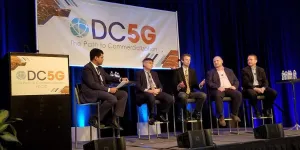
On November 12th, Dr. Rikin Thakker, MMTC Vice President of Telecommunications and Spectrum Policy, moderated a panel discussion on “Winning the Global Race to 5G: Why it all Comes Down to Policy and the Pace of Infrastructure Deployment” at the DC5G Summit.
The Federal Communications Commission (FCC) has publicly stated that its primary mission over the next few years is to ensure that the United States wins the race to full 5G deployment, while allowing private industry to ultimately determine how it will be done. This presents a unique challenge for the U.S. telecommunications industry - how can it get investment capital, government policy, and commercial markets moving at the same speed to outpace international infrastructure developments? How can industry leverage government support in a way that puts the nation at an advantage in the race to 5G?
Panelists included Qualcomm Senior Vice President of Spectrum Strategy and Technology Policy Dean Brenner, Intelsat US Senior Vice President of Strategy and Asset Management Bruno Fromont , Crown Castle Senior Government Relations Counsel Bob Ritter, and CommScope Vice President of Global Strategy and Business Development Trevor Smith.

[click to continue…]

The Federal Communications Commission has announced the creation of a new Disaster Response and Recovery working group on its Broadband Deployment Advisory Committee. Multicultural Media, Telecom and Internet Council (MMTC) Vice President of Telecommunications and Spectrum Policy Dr. Rikin Thakker will serve as a member of the working group.



According to an FCC statement, “The Working Group is charged with recommending measures that can be taken to improve the resiliency of broadband infrastructure before a disaster occurs, as well as actions that can be taken to more quickly restore broadband infrastructure following a disaster. Following what he heard on the ground in the aftermath of Hurricane Michael, the Chairman has also charged the working group with developing best practices for coordination among wireless providers, backhaul providers, and power companies during and after a disaster.” [click to continue…]

On November 15th and 16th, in recognition of the Department of Labor’s National Apprenticeship Week, MMTC and the National Urban League (NUL) are holding two events during the Carolinas Alliance for Success in Education (CASE) Summit in Charlotte, North Carolina.

Event 1: “The National Urban League’s Urban Apprenticeship Jobs Program (UAJP): A Community-Based Partnership to Advance Registered Apprenticeship”
Thursday, November 15, 2018
: 6:45 PM - 7:45 PM

This event is a community forum held during the Carolinas Alliance for Success in Education (CASE) Summit. Ronald Marlow, the National Urban League’s Vice President of Workforce Development, will speak on the UAJP’s efforts to advance registered apprenticeship. Mr. Marlow will emphasize the efforts and progress of the HBCU Apprenticeship Consortium in partnership with NAFEO, and he will speak on how CASE HBCUs can participate in this important initiative. Mr. Marlow is joined by NUL’s partner in the UAJP, Maurita Coley Flippin, President and CEO of the Multicultural Media, Telecom and Internet Council (MMTC). [click to continue…]