Julia Bluhm is a 14-year-old blogger who recently received widespread attention when she staged a nationwide protest against Seventeen Magazine for the images they portrayed to young girls. Today, Bluhm shares her perspectives on the media and how it affects perceptions and perpetuates stereotypes.
As a little girl, I wore Lands’ End clothes; I played with American Girl Dolls; and swung on the swings. I lived in a two-story house on a little street, in a little town. And that was my own little world. Anything outside was kind of a mystery.
I don’t know if I’ve ever said anything mean to anyone. But what I’ve only now realized is that I was guilty of something: Judging. Like I said, I saw lot of people walking around who were mysteries to me. I knew nothing about them, and the way they dressed and looked was different and made them even more mysterious.
The only things I knew about these kinds of people who I had never talked to, were the things I learned through the media. The media unleashes thousands of stereotypes, and they become the reality for kids who don’t know any better.
That means that people with tattoos and piercings were “scary.” Girls who wore short skirts and lots of makeup were “ditsy and dumb.” Without really knowing what I was doing, I was judging people every day, and so were all of my friends.
The media also sends messages to us girls. They tell us that “skinny” is a synonym to “pretty,” and that not only forms a negative body image for girls, but it also allows people to easily judge based on body type. People get picked on all the time about their body type. Why? Because the media tells us that only one body type is good, and others aren’t as good. Photoshop doesn’t help. Check out the Seventeen magazine petition for more info on that.
I never really realized how much we used to judge people, until I got involved in SPARK, and opened my eyes. Just the other day, some girls at school were having a conversation that went something like this:
“I don’t understand why people would ever want to get a bunch of piercings. It’s kind of icky. And why do people wear shorts so short that they’re practically underwear? That’s just asking for attention from creeps.”
The whole time I was sitting there uncomfortably, surprised at how much their conversation bothered me. They looked at me, expecting me to nod and agree with them. I probably would have if I were still eleven, and didn’t know any better.
“Well, I think people should wear whatever makes them happy,” I said. “ That’s all that matters.”
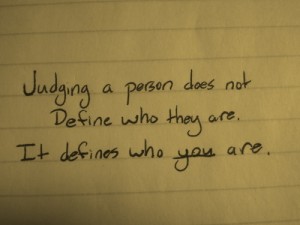 I’ve started hanging out with a bunch of different types of people recently. Now I know that none of those stereotypes I once believed are actually true. Someone’s personality, or how nice or smart they are, has nothing to do with how they look. We all know that stereotypes don’t define people, but do we believe it 100% of the time? I knew it, but I still judged people. It was an unconscious thing, and I didn’t think it was really big deal. But now I know it is.
When I witness people judging, it hurts me, even if it isn’t about me at all. Judging is something that’s really easy to do. People (even really nice people who would never hurt a fly) do it all the time. The media drills certain ideas into our brains, and makes it normal to think about people in unhealthy, unpleasant ways. It’s all good and fine until you wake up one morning and somebody’s making assumptions about you.
I think I’m in the process of becoming my own person, and that process involves a lot of change. I’m starting to present myself differently, talk differently, and believe in different things. I’m becoming independent. That puts me at a really vulnerable place for judging, I think. I’m kind of mystery to myself, so of course I’ll be a mystery to other people. And when we let the media “solve” our mysteries, we run into a lot of problems.
Yes, there will always be mean people we’ll want to stay away from, and nice people who are possible friend-material. But we won’t be able to tell who’s who by looking at them, or by letting the media decide for us. Ultimately, if you don’t judge people, there will be a million more people you’ll want to talk to, and meet. And that will basically lead to having a million more friends who are all interesting in their own ways. In the end, your Facebook newsfeed will be pretty exciting.
This article originally appeared on SPARK a Movement.