Part I
What does technological innovation contribute to improving our standard of life?
Questions as such are provoked by the emergence of new hi-tech devices like wearable computer glasses introduced to the public in April.
The device integrates artificial intelligence and creates an augmented view of reality for the wearer. The aesthetic appeal and novelty of the computer glasses is legitimately noteworthy—they are possibly the coolest consumer-priced artificial intelligence devices ever produced. One could envision being in an episode of Inspector Gadget wearing them.
Indeed, the excitement and expectations roused by the emergence of the device are reminiscent of the feelings brought on by the iPhone’s arrival in the nation’s tech marketplace.
But despite the “coolness factor” of the glasses or of the iPhone, one wonders what value these products—or any other gadgets—contribute to improving our standard of life?
More generally, how does technological innovation and efficiency for its own sake help us raise the bar?
Technology for its own sake is not a substitute (nor will it ever be) for measurable improvements in the quality of life for average U.S. citizens. Each new software version and new media consumption device released makes it easier for us to lose sight of the substance of previous generations’ expectations for the future.
Is Digital Tech Consumption Opiating the Masses?
Economist John McDermott made the observation forty years ago that technological innovation, like “no other single subject, is so universally invested with high hopes for the improvement of mankind generally and of Americans in particular.”
This quote is taken from an article whose title suggests that technology is not an “unalloyed blessing” offering an end to poverty, universal equality of opportunity, prosperity, and harmless social revolution, but rather something much more familiar to human societies. The thrust of McDermott’s analysis is to point out that technology for its own sake is a societal opiate, and novelty should not distract us from discerning its social implications.
Of course, McDermott’s analyses were not particularly prescient because the iPhone had not yet been invented, and the iPhone is the new American dream, right? Owning a smartphone device indicates that, in fact, your life is better than that of your predecessors. You clearly have far greater mobility, and the proof is that Siri can now remind you to go pick up your dry cleaning. These are facetious examples, but some in the U.S. may believe that technological innovation is a panacea, and therefore the smartphone is plausible as the new icon of American social mobility.
Measuring the Quality of Our Standard of Life
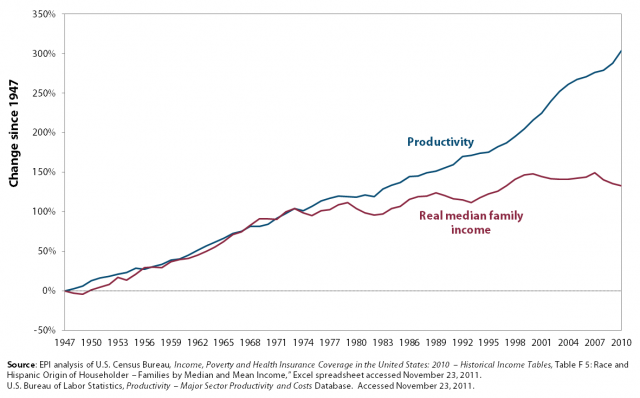
When it comes to measuring improvements in the quality of life in the U.S. over the last thirty-five years, it is clear that our productivity has increased—the result of efficiency gains from technological advancement—but real income for middle-income families has not improved.
Although Americans might now be able to handle 100 tasks per hour versus the 10 tasks per hour that our grandparents completed, the gains in efficiency have not invariably meant a higher standard of living. The fact is that the market adjusts itself to compensate for whatever level of efficiency we achieve—meaning that we don’t actually get an extra hour of recreation because we are more efficient now than 20 years ago. Anecdotal evidence offered by graphic designer and blogger Dyske Suematsu gets to this very point. Suemastu contends that “…with the increase in efficiency, today’s designers can take on 50 jobs a year. Has the quality of life for graphic designers increased because of technology? The answer is no. Taking into consideration the rate of inflation, they are not getting paid anymore than they did 20 years ago, but are now required to produce 10 times more a year.”
Stateofworkingamerica.org has quantified this data. According to the organization, “the benefits of increased productivity over the last 35 years have not gone to the middle class.”
Productivity and real median family income growth, 1947-2010:
 Of course, one might be tempted to say that perhaps the next thirty-five years will be different.
Hal Varian, chief economist at Google, takes the view that in fact things will be different. In a special report on the future of the global economy, Varian measures social progress as access to cheaper tech gadgets, and he is not alone in fusing the two ideas.
Varian believes that “a simple way to forecast the future is to look at what rich people have today; middle-income people will have something equivalent in 10 years, and poor people will have it in an additional decade. Think of VCRs, flat screens, TVs, mobile phones, and the like. Today, rich people have chauffeurs. In 10 years or less, middle-income drivers will be able to afford robotic cars that drive themselves, at least in some circumstances.”
In the next thirty-five years, when tech gadgets lose all novelty, perhaps it will be easier for us, in the words of McDermott, to discern “the empirical character of contemporary technology,” or in other words, to discern the difference between the social and economic implications of the rise and spread of “gadget-ocracy” and those meaningful changes in institutional systems which affect the quality of life in the United States.
Today, it is still true that both contingency and privilege amount to very different life outcomes in the U.S., and our relative level of mobility as a society compared to other industrialized nations is low.
Increasing the standard of living in the U.S. means that children are able to achieve more than their parents (see Webster’s: the American Dream) and that entails having better access to quality education, healthcare etc. According to the Pew Center’s Economic Mobility Project the link between your parents education and your economic, educational and socio-emotional outcomes is stronger in the U.S. than in many other developed countries. Just to be clear, this is the opposite of a highly mobile society and in this case the reference is not mobile tech but social and economic mobility explicitly measured.